
Modern manufacturing relies heavily on materials that improve strength, durability, finish, and performance. While metals and polymers often receive the most attention, industrial minerals quietly play a critical role in almost every manufacturing sector—from paints and plastics to ceramics, rubber, construction materials, and paper.
Industrial minerals are naturally occurring minerals that are mined and processed for their physical and chemical properties rather than their metal content. These minerals are used as fillers, functional additives, pigments, or raw materials that enhance the efficiency and quality of manufactured products.
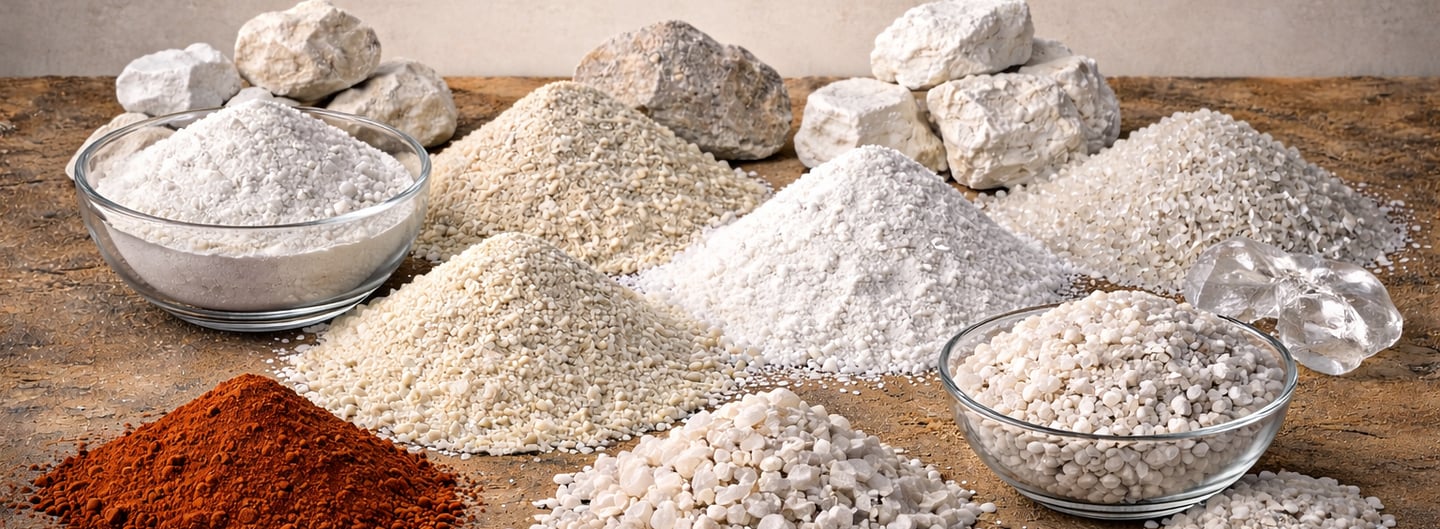
Industries across the world depend on minerals such as dolomite powder, china clay powder, talcum powder, calcite powder, silica/quartz powder, natural red oxide, and marble or silica grains to improve product performance, reduce manufacturing costs, and ensure consistency.
Understanding Industrial Minerals
Industrial minerals are valued for specific characteristics such as:
Particle size and uniformity
Whiteness and brightness
Chemical stability
Hardness and durability
Opacity and coverage
Absorption and reinforcement properties
These properties allow manufacturers to control the texture, strength, finish, and functionality of their products.
Unlike metals, industrial minerals are often used in powder or granular form, making them ideal for blending into industrial formulations.
Key Industrial Minerals Used in Manufacturing
1. Dolomite Powder
Dolomite powder is produced from the mineral dolomite, composed of calcium magnesium carbonate.
Key Properties
High magnesium content
Good hardness and durability
Excellent chemical stability
Applications in Manufacturing
Dolomite powder is widely used in:
Paint and coatings as a filler
Glass manufacturing
Rubber and plastic compounding
Construction materials and wall putty
In paint formulations, dolomite helps improve strength, weather resistance, and surface durability.
2. China Clay Powder
China clay, also known as kaolin, is a soft white mineral widely used in industries requiring high whiteness and smooth texture.
Key Properties
Excellent whiteness and brightness
Fine particle size
Good dispersion in formulations
Applications
China clay powder is used in:
Paint and coatings
Paper manufacturing
Ceramics and sanitaryware
Rubber and plastics
In paints and coatings, it improves opacity, suspension, and smooth surface finish.
3. Talcum Powder
Talcum powder is one of the softest minerals known and is widely used as a functional filler in manufacturing.
Key Properties
Excellent lubricity
Heat resistance
Chemical inertness
Applications
Talcum powder is commonly used in:
Plastic compounding
Automotive components
Rubber products
Paints and coatings
In plastics, talc improves dimensional stability, stiffness, and heat resistance.
4. Calcite Powder
Calcite powder is a naturally occurring form of calcium carbonate widely used in industrial formulations.
Key Properties
High brightness and whiteness
Fine particle distribution
Cost-effective filler material
Applications
Calcite powder is widely used in:
Paint manufacturing
PVC and plastic products
Adhesives and sealants
Paper industry
It helps improve opacity, surface smoothness, and cost efficiency in manufacturing.
5. Silica / Quartz Powder
Silica powder, derived from quartz, is a highly durable mineral with excellent hardness.
Key Properties
High silica purity
Excellent hardness
Thermal stability
Applications
Quartz powder is used in:
Glass manufacturing
Ceramics
Paints and coatings
Construction materials
It enhances strength, abrasion resistance, and durability in finished products.
6. Natural Red Oxide
Natural red oxide is an iron oxide mineral used primarily as a pigment and coloring agent.
Key Properties
Strong pigmentation
UV resistance
Chemical stability
Applications:
Red oxide is widely used in:
Cement and concrete coloring
Floor coatings
Paints and primers
Construction materials
It provides durable and long-lasting color in industrial products.
7. Marble and Silica Grains
Marble and silica grains are used in granular form in construction and surface applications.
Key Properties
High hardness
Decorative appearance
Strong durability
Applications
These grains are used in:
Decorative flooring
Terrazzo surfaces
Construction materials
Landscaping and architectural finishes
They provide texture, strength, and visual appeal to finished surfaces.
Why Industrial Minerals Are Essential in Manufacturing
Industrial minerals play several critical roles in modern manufacturing:
1. Cost Efficiency
Mineral fillers reduce the cost of raw materials while maintaining product quality.
2. Performance Enhancement
They improve strength, durability, opacity, and heat resistance in industrial products.
3. Product Consistency
Fine particle control ensures uniform performance in manufacturing processes.
4. Improved Processing
Industrial minerals enhance flow, dispersion, and mixing properties in formulations.
Industrial Minerals in Modern Industries
Many industries depend heavily on mineral fillers and additives.
Major industries include:
Paint and coatings
Paper manufacturing
Rubber and plastics
Construction materials
Ceramics and glass
These industries rely on minerals to optimize performance while maintaining cost-effective production.
The Role of Reliable Mineral Manufacturers
For manufacturers, the quality and consistency of industrial minerals directly affect the performance of their products. Precise particle size distribution, controlled purity, and consistent supply are essential for maintaining production standards.
Kamal Industries specialize in supplying high-quality industrial minerals including calcite powder, talcum powder, dolomite powder, china clay powder, silica/quartz powder, natural red oxide, and marble or silica grains for multiple manufacturing sectors.
With advanced processing infrastructure and strict quality control, industrial mineral manufacturers help ensure that downstream industries receive materials tailored to their exact specifications.
Conclusion
Industrial minerals form the backbone of modern manufacturing. Materials such as dolomite powder, china clay powder, talcum powder, calcite powder, silica/quartz powder, natural red oxide, and marble or silica grains help industries improve product strength, performance, durability, and cost efficiency. From paints and plastics to construction and ceramics, these minerals play a vital role in ensuring consistent quality and reliable production processes.
As industries continue to demand higher performance materials, the importance of high-quality processed industrial minerals will only continue to grow.
Looking for a reliable supplier of industrial minerals?
Kamal Industries manufactures and supplies a wide range of industrial minerals tailored to the needs of manufacturers across multiple industries.
👉 Contact Kamal Industries today to discuss your requirements or request product specifications and samples.
Kamal Industries
Office Address: E-446 C, Matsya Industrial Area, Alwar, Rajasthan 301030.
Factory Address:
E-446 C&D, Matsya Industrial Area, Alwar, Rajasthan 301030.
G-288, Matsya Industrial Area, Alwar, Rajasthan 301030.
© 2026. All rights reserved.
Email: kamalindalwar@gmail.com
Contact No: +919351773848