For sales and product enquiries, contact: kamalindalwar@gmail.com | +91 9351773848

Talcum Powder: Properties, Applications, and Industrial Importance
Discover the properties, applications, and industrial importance of talcum powder across paints, plastics, paper, rubber, ceramics, and construction industries. Learn how talcum improves product performance, processing efficiency, smoothness, thermal stability, and cost optimization in modern manufacturing.
5/19/20263 min read
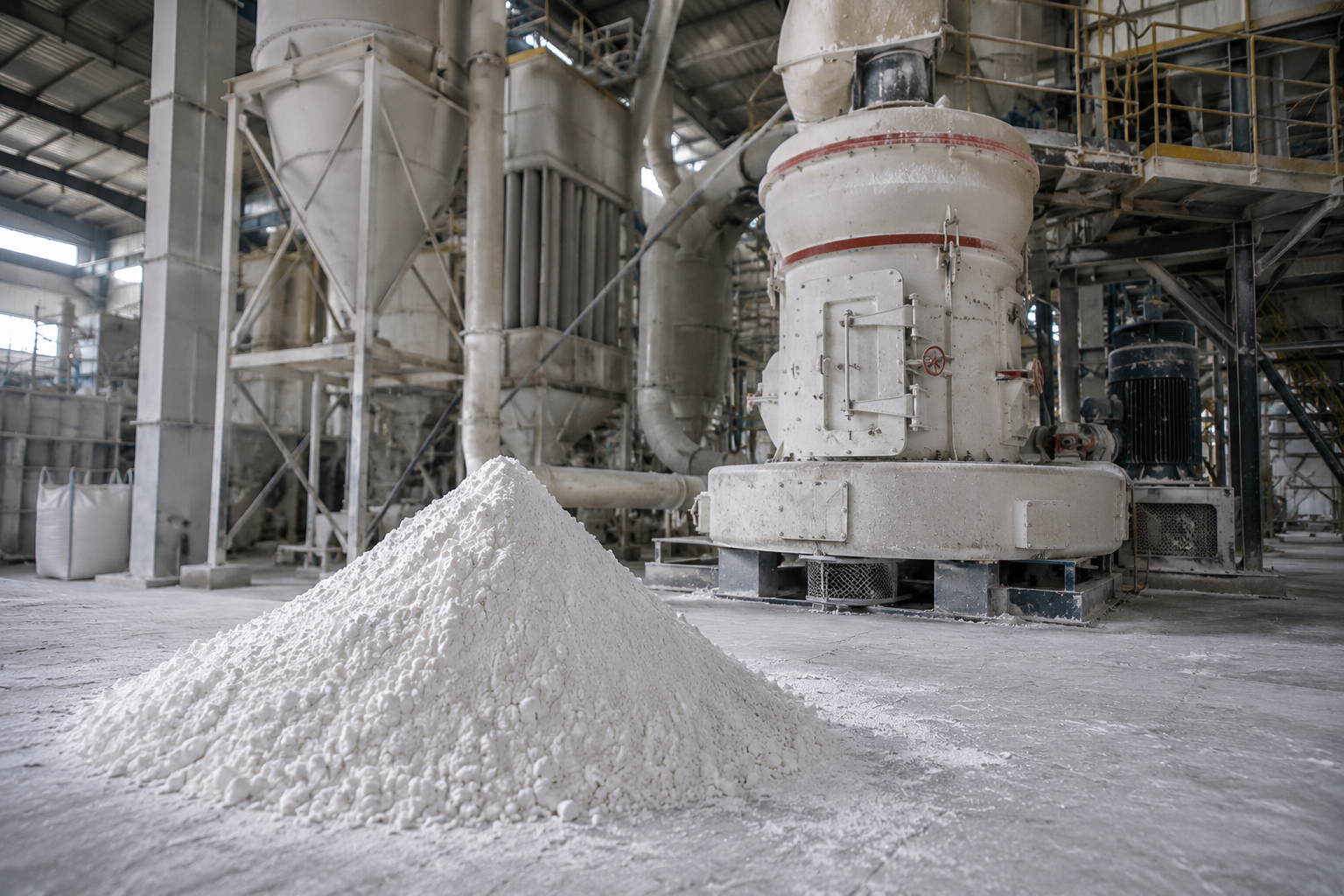
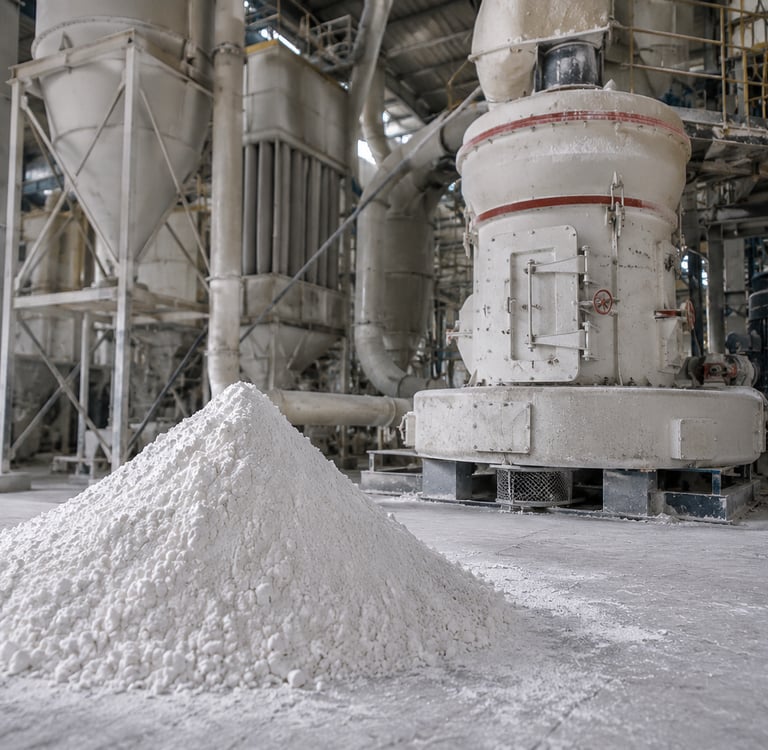
Among the many industrial minerals used across manufacturing industries, Talcum Powder (Talc) stands out for its versatility, softness, chemical stability, and cost-effectiveness. From paints and plastics to paper and rubber, talc plays a critical role in improving product performance, processing efficiency, and overall quality. Its unique physical and chemical characteristics make it one of the most widely used functional fillers in industrial applications.
What is Talc?
Talc is a naturally occurring mineral composed mainly of hydrated magnesium silicate. It is known as the softest mineral on the Mohs hardness scale and possesses a distinctive lamellar or plate-like structure.
This unique structure gives talc several valuable industrial properties such as:
Smoothness
Lubricity
Chemical inertness
Hydrophobicity
High heat resistance
Industrial talcum powder is processed into fine powders of different mesh sizes and micron grades depending on the application requirement.
Key Properties of Talc
1. Softness
Talc is the softest known mineral, which allows it to provide a smooth feel and excellent processing characteristics in multiple applications.
Benefits:
Reduces equipment wear
Improves surface finish
Enhances workability
2. Lamellar Structure
Talc particles have a plate-like shape that improves reinforcement and barrier properties.
Advantages:
Better dimensional stability
Improved stiffness in plastics
Enhanced crack resistance in coatings
3. High Whiteness
High-whiteness talc is preferred in industries where brightness and appearance are important.
Applications:
Decorative paints
Paper coatings
Plastic compounds
Wall putty
4. Chemical Inertness
Talcum Powder does not easily react with most chemicals, making it highly stable in industrial formulations.
Benefits:
Better formulation stability
Improved product durability
Resistance to chemical degradation
5. Hydrophobic Nature
Talcum Powder naturally repels water due to its hydrophobic surface characteristics.
Advantages:
Improved moisture resistance
Better corrosion protection in coatings
Reduced water absorption
6. Thermal Resistance
Talc performs well at elevated temperatures, making it suitable for heat-sensitive applications.
Benefits:
Improved thermal stability
Better heat resistance in plastics
Enhanced processing performance
7. Lubricity
The natural slip properties of talc improve processing efficiency in many manufacturing operations.
Benefits:
Smoother processing
Reduced friction
Better flow characteristics
Industrial Applications of Talc
Talc in Paint Industry
Talc is widely used as a functional filler in decorative and industrial paints.
Functions of talc in paints:
Improves smoothness
Enhances suspension properties
Reduces cracking
Improves scrub resistance
Enhances matting effect
Helps control gloss
Its lamellar structure also improves barrier properties and corrosion resistance in coatings.
Talc in Plastic Industry
Talcum Powder is commonly used in polypropylene (PP) and engineering plastic compounds.
Benefits in plastics:
Improved stiffness
Better dimensional stability
Increased heat resistance
Reduced shrinkage
Improved mechanical strength
Automotive and appliance industries extensively use talc-filled plastic compounds.
Talc in Paper Industry
In paper manufacturing, talc helps improve both processing and final product quality.
Applications:
Pitch control
Smoothness improvement
Better printability
Improved opacity
Reduced stickiness in recycled paper
Talc is especially useful in recycled paper processing due to its anti-stick properties.
Talc in Rubber Industry
Talc functions as a reinforcing and processing filler in rubber products.
Benefits:
Improved processing
Better surface finish
Reduced tackiness
Cost optimization
Enhanced dimensional stability
Talc in Ceramics
Talc is used in ceramic formulations to improve thermal and mechanical performance.
Advantages:
Better firing behavior
Improved strength
Reduced shrinkage
Enhanced thermal resistance
Talc in Construction Materials
Talc is used in products such as:
Wall putty
Adhesives
Sealants
Construction compounds
It improves workability, crack resistance, and smoothness.
Important Quality Parameters in Talc Powder
When selecting talcum powder for industrial use, manufacturers typically evaluate:
Whiteness
Particle size distribution
Mesh size
Brightness
Oil absorption
Purity
Moisture content
Bulk density
The right grade selection depends on the end-use application and processing requirements.
Choosing the Right Talc Grade
Different industries require different talc specifications.
For example:
Fine micron grades are preferred for paints and plastics
High-whiteness grades are important for decorative applications
Controlled particle size is critical for consistent performance
Selecting the right supplier and grade helps manufacturers improve product quality while optimizing production costs.
Conclusion
Talcum Powder is far more than just a filler mineral. Its unique combination of softness, lamellar structure, hydrophobicity, chemical stability, and thermal resistance makes it an essential performance-enhancing material across industries.
From improving paint finish and plastic rigidity to enhancing paper quality and rubber processing, talc continues to play a vital role in modern manufacturing.
As industries increasingly focus on performance, efficiency, and cost optimization, high-quality talc powders remain an important part of industrial formulations worldwide.
Kamal Industries
Office Address: E-446 C, Matsya Industrial Area, Alwar, Rajasthan 301030.
Factory Address:
E-446 C&D, Matsya Industrial Area, Alwar, Rajasthan 301030.
G-288, Matsya Industrial Area, Alwar, Rajasthan 301030.
© 2026. All rights reserved.
Email: kamalindalwar@gmail.com
Contact No: +919351773848