For sales and product enquiries, contact: kamalindalwar@gmail.com | +91 9351773848

Paint Formulation Guide: Key Fillers (Calcite, Talc, Dolomite, China Clay, Calcium Chloride) and Their Role in Performance & Cost
Explore key fillers used in paint including calcium chloride, calcite, talc, dolomite, and china clay. Learn how the right fillers improve paint performance, finish, and cost efficiency.
MANUFACTURING RAW MATERIALSINDUSTRIAL MINERALSINDUSTRIAL CHEMICALSCALCIUM CHLORIDEMINERAL APPLICATIONSPAINT INDUSTRYINDUSTRY INSIGHTS
3/25/20263 min read
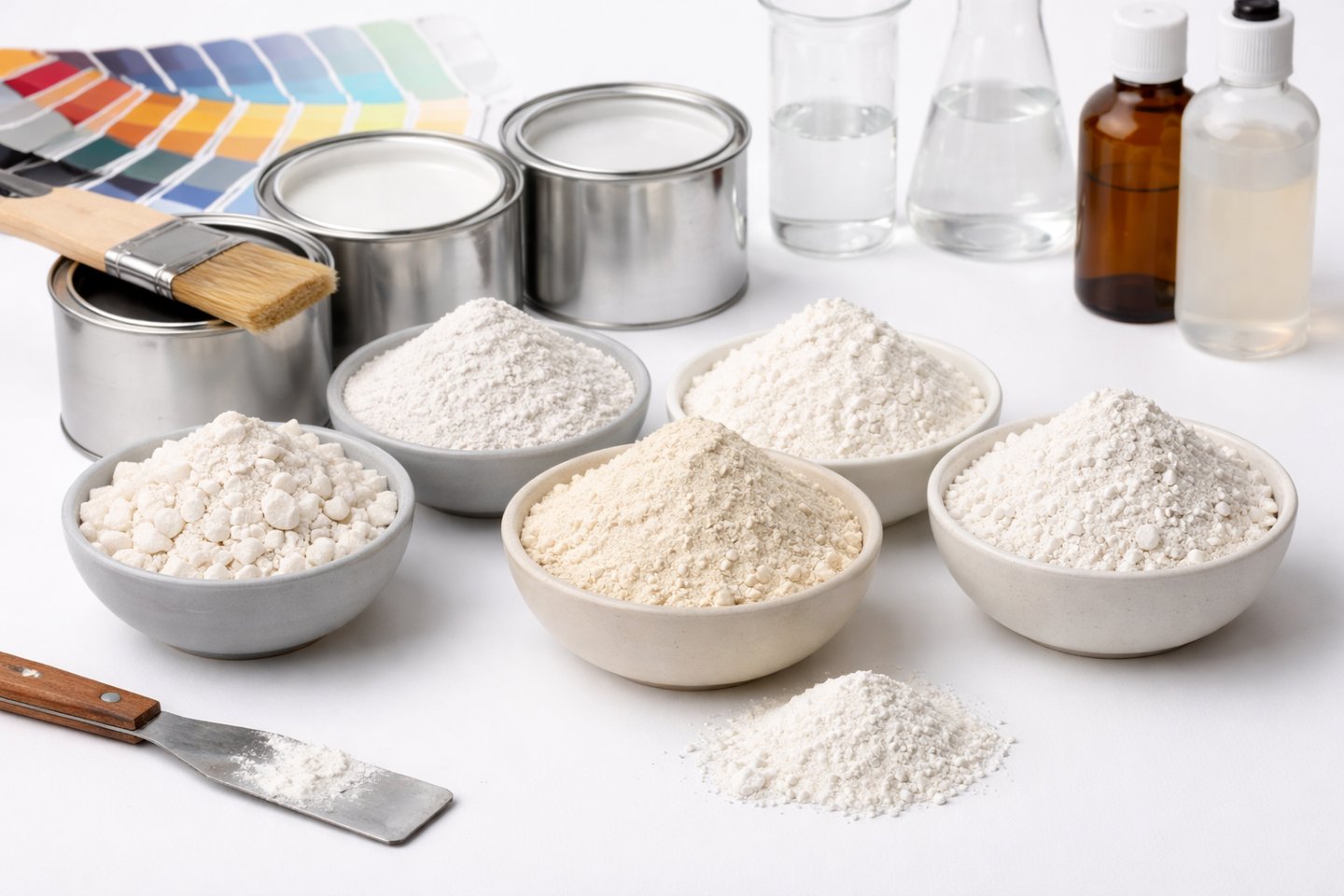
Paint formulation is a balance of science and economics. While pigments provide color and binders ensure film formation, fillers (extenders) play a critical role in defining performance, application properties, and overall cost efficiency.
Understanding how different fillers behave—and how to combine them effectively—can help manufacturers create paints that are both high-performing and commercially competitive.
What Are Fillers in Paint?
Fillers are inorganic materials added to paint formulations to:
Reduce raw material cost
Improve mechanical properties
Enhance surface finish and smoothness
Control viscosity and workability
Optimize pigment efficiency
Though often seen as cost reducers, modern fillers are functional ingredients that directly impact product quality.
Key Fillers Used in Paint
1. Calcite (Calcium Carbonate)
Role in Paint:
Calcite is the backbone of most paint formulations due to its versatility and cost-performance balance.
Key Contributions:
Improves whiteness and brightness
Enhances opacity (when used with TiO₂)
Provides smooth surface finish
Reduces formulation cost
Performance Impact
Fine and ultrafine calcite grades significantly improve film uniformity and finish, making them essential for premium emulsions.
Typical Applications
Wall putty
Interior & exterior emulsions
Primers
2. Talc (Hydrated Magnesium Silicate)
Role in Paint
Talc is known for its plate-like particle structure, which contributes to improved film properties.
Key Contributions
Enhances suspension and reduces settling
Improves water and weather resistance
Provides a silky, smooth finish
Increases crack resistance
Performance Impact
Talc acts as a functional barrier, improving durability and extending the life of exterior coatings.
Typical Applications
Exterior paints
Industrial coatings
Wood coatings
3. Dolomite (Calcium Magnesium Carbonate)
Role in Paint
Dolomite is widely used in cost-sensitive formulations as a bulk filler.
Key Contributions
Improves hardness and abrasion resistance
Adds structural strength
Reduces formulation cost
Performance Impact
While not as white as calcite, dolomite provides mechanical durability, making it suitable for high-loading systems.
Typical Applications
Wall putty
Primers
Economy paints
4. China Clay (Aluminium Silicate)
Role in Paint
China clay acts as a functional filler and opacifier, particularly in water-based systems.
Key Contributions
Improves opacity and coverage
Enhances suspension stability
Provides better film uniformity
Contributes to matte finish
Performance Impact
Its fine particle size and plate-like structure enable better dispersion and smoother coatings, especially in emulsions and putty.
Typical Applications
Wall putty
Primers
Emulsions
Matte finishes
5. Calcium Chloride
Role in Paint
Calcium chloride is not a traditional filler but plays an important supporting role in certain formulations.
Key Contributions
Acts as a moisture regulator
Improves drying in humid conditions
Prevents lump formation in powder-based products
Enhances storage stability
Performance Impact
In high-humidity environments, calcium chloride helps maintain product consistency and shelf life, especially in dry mix systems like wall putty.
Typical Applications
Wall putty (powder form)
Construction coatings
Moisture-sensitive formulations
How Fillers Impact Paint Performance
A well-designed filler system influences:
1. Surface Finish
Fine calcite + talc → smoother, premium finish
Coarser fillers → rougher texture but lower cost
2. Durability
Talc → better weather resistance
Dolomite → improved hardness and abrasion resistance
3. Cost Optimization
Calcite and dolomite reduce reliance on expensive pigments
Proper blending minimizes cost without compromising quality
4. Workability
China clay improves suspension and application
Proper filler mix ensures easy brushing and leveling
Choosing the Right Filler Combination
Different paint categories require different strategies:
Premium Paints
→ Ultrafine calcite + talc + China clayMid-Range Paints
→ Balanced calcite + China clayEconomy Paints
→ Dolomite + standard calcite
Importance of Particle Size
Particle size (mesh/micron) plays a crucial role:
20–40 micron → Bulk filling, cost reduction
10–20 micron → General-purpose performance
2–10 micron → Smooth finish, higher opacity
Even small variations in particle size can significantly impact finish quality, dispersion, and consistency.
Why Choosing the Right Supplier Matters
Even the best formulation can fail with inconsistent raw materials.
Variations in:
Particle size distribution
Whiteness
Oil absorption
Chemical composition
can lead to:
Inconsistent finish
Poor dispersion
Increased production time
Batch-to-batch variation
This is why working with a reliable supplier like Kamal Industries is essential—ensuring consistent quality, controlled particle size, and dependable supply for every batch.
Final Thoughts
Fillers are not just cost-saving components—they are critical to paint performance. Materials like calcite, talc, dolomite, china clay, and calcium chloride each play a unique role in shaping the final product.
Manufacturers who understand how to optimize these fillers can achieve:
Superior finish and durability
Better cost control
Consistent product quality
In today’s competitive market, mastering filler selection is not optional—it’s a key driver of success in paint formulation.
Kamal Industries
Office Address: E-446 C, Matsya Industrial Area, Alwar, Rajasthan 301030.
Factory Address:
E-446 C&D, Matsya Industrial Area, Alwar, Rajasthan 301030.
G-288, Matsya Industrial Area, Alwar, Rajasthan 301030.
© 2026. All rights reserved.
Email: kamalindalwar@gmail.com
Contact No: +919351773848