


Particle size plays a critical role in determining the performance of industrial mineral powders. Whether used in paints, plastics, paper, rubber, or construction materials, the fineness of minerals directly affects product quality, processing efficiency, and final application performance.
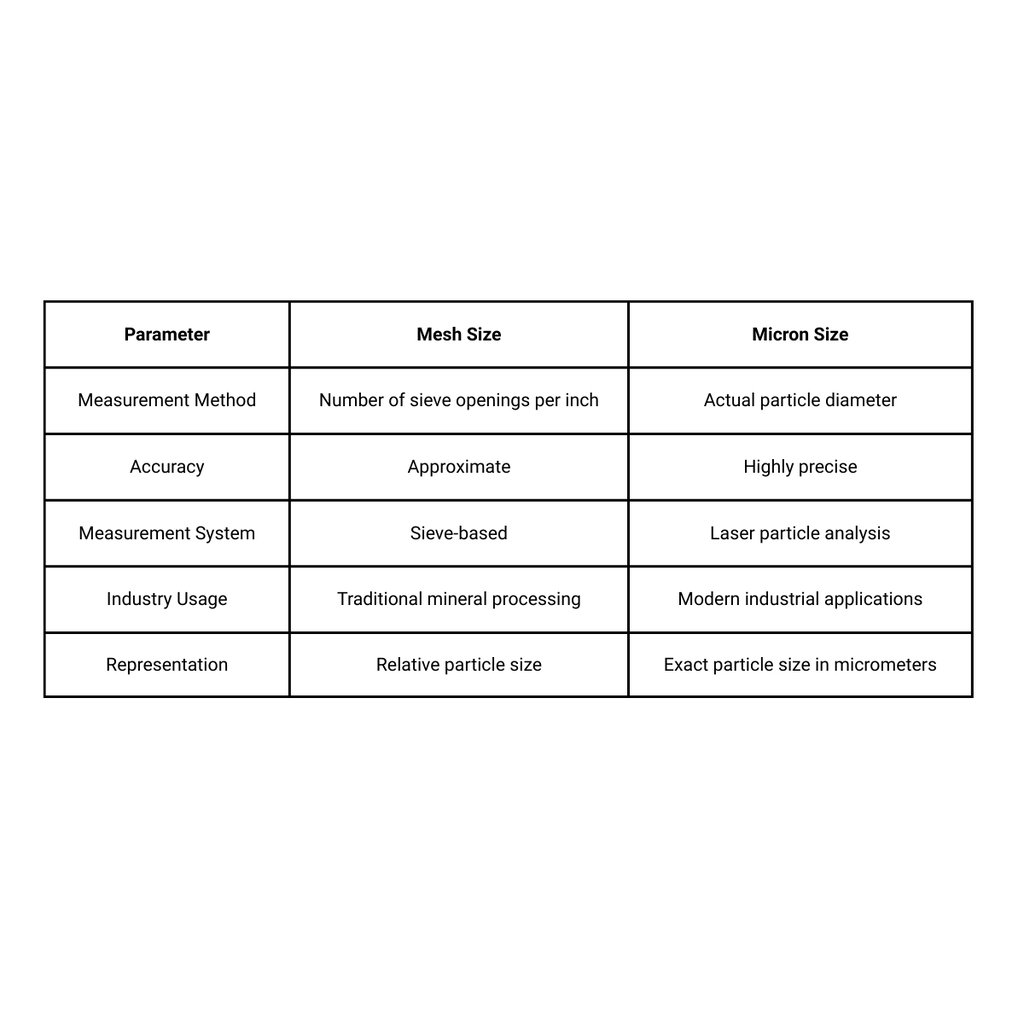
Two common terms used to describe particle size in mineral processing are mesh and micron. While they both refer to particle size, they measure it in different ways. Understanding the difference between mesh and micron is essential for manufacturers, procurement teams, and technical professionals working with mineral fillers.
What is Mesh Size?
Mesh size refers to the number of openings per inch in a sieve used to separate particles.
For example:
100 Mesh means there are 100 openings per inch in the sieve
200 Mesh means 200 openings per inch
325 Mesh means 325 openings per inch
The higher the mesh number, the smaller the particle size because the particles must pass through finer openings.
Mesh measurement is commonly used in traditional mineral processing industries and is often referenced when discussing materials such as:
Calcite powder
Dolomite powder
Talcum powder
Silica / quartz powder
China clay powder
However, mesh size only provides a sieve-based estimate of particle size and does not represent the exact particle diameter.
What is Micron Size?
A micron (µm), also called a micrometer, is a unit of length equal to:
1 micron = 0.001 millimeters
Micron measurement represents the actual particle diameter, making it much more precise than mesh measurement.
Modern mineral processing plants typically use advanced instruments such as laser particle size analyzers to measure particle size in microns.
For example:
20 micron powder contains particles averaging around 20 µm
10 micron powder is significantly finer
2 micron powder is considered ultra-fine and used in high-performance applications
Micron-based measurement is widely used in industries requiring tight quality control and consistent product performance.
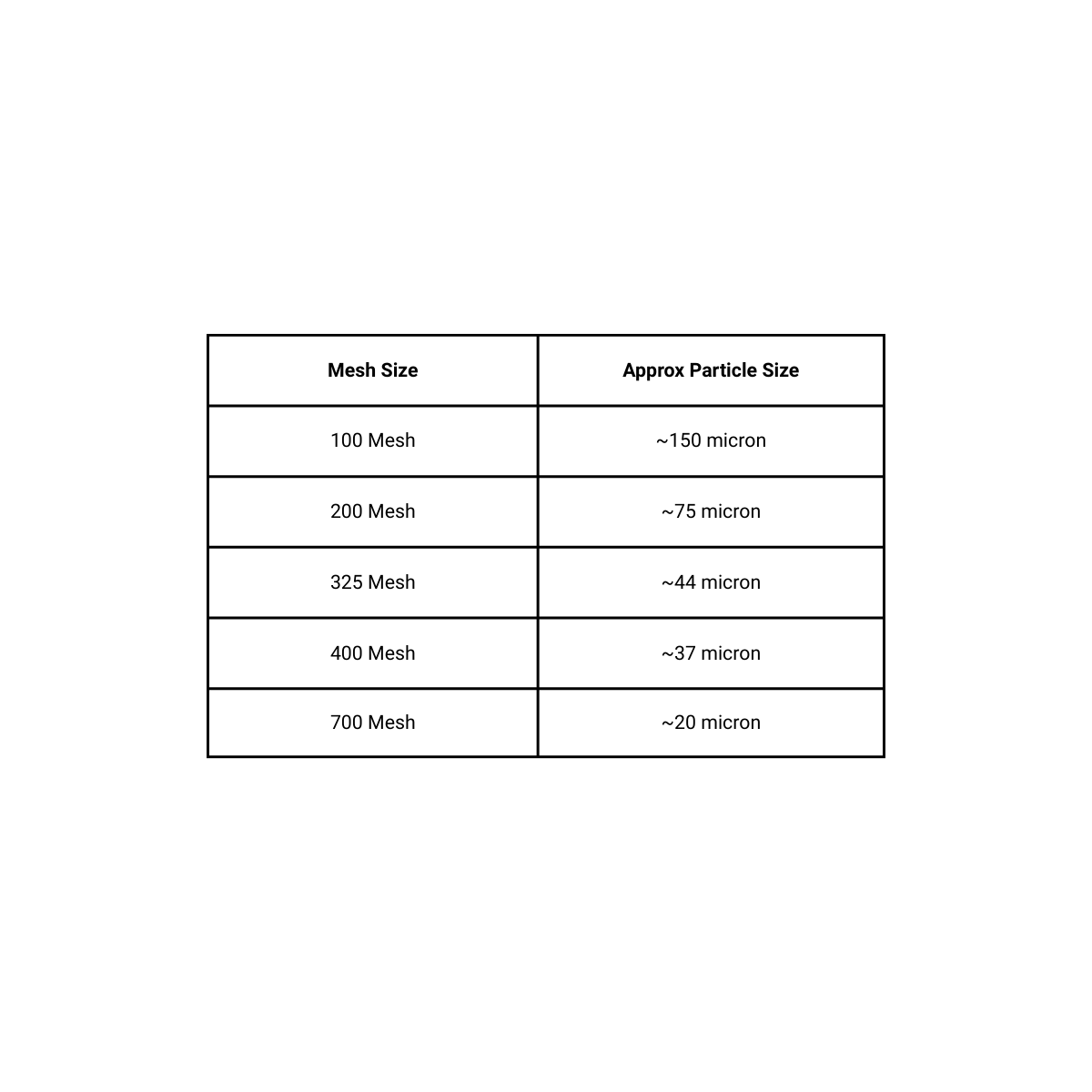
Approximate Mesh to Micron Conversion
Although mesh and micron measure particle size differently, approximate conversions are often used in the mineral industry.
These conversions are approximate because actual particle distribution varies depending on grinding technology and mineral characteristics.
Why Particle Size Matters in Industrial Applications
The particle size of mineral powders significantly impacts product performance in many industries.
Paint Industry
Fine minerals improve:
Smooth surface finish
Opacity and brightness
Paint film strength
Materials such as calcite powder, talcum powder, and china clay are often supplied in 10–20 micron grades for coatings.
Plastic Industry
Controlled particle size improves:
Dispersion in polymer matrices
Mechanical strength
Surface finish
Paper Industry
Fine mineral fillers enhance:
Paper smoothness
Printability
Opacity
Rubber Industry
Mineral powders with optimized particle size help improve:
Dimensional stability
Reinforcement
Processing efficiency
Factors That Affect Mineral Powder Particle Size
Several factors influence the final particle size distribution during mineral processing:
Grinding technology used
Type of mineral
Hardness and density of the material
Air classification and separation systems
Quality control during milling
Modern micronizing systems allow manufacturers to produce ultra-fine mineral powders with controlled particle size distribution, ensuring consistent performance across industrial applications.
Industrial Mineral Solutions from Kamal Industries
At Kamal Industries, high-quality mineral powders are processed with controlled particle size to meet the requirements of modern manufacturing industries.
Our range of industrial minerals includes:
Calcite Powder
Dolomite Powder
Talcum Powder
China Clay Powder
Silica / Quartz Powder
Natural Red Oxide
These materials are widely used across paint, paper, plastic, rubber, and construction industries, where consistent particle size plays a critical role in product quality.
Conclusion
Mesh and micron are both essential concepts in understanding the fineness of mineral powders. While mesh provides a traditional sieve-based reference, micron measurement offers precise particle size analysis used in modern industrial mineral processing.
For manufacturers and procurement teams, understanding the relationship between mesh and micron helps in selecting the right mineral grade for optimal product performance.
As industrial applications become more advanced, micron-based particle size control continues to play an increasingly important role in ensuring quality, efficiency, and consistency in mineral-based manufacturing processes.
Kamal Industries
Office Address: E-446 C, Matsya Industrial Area, Alwar, Rajasthan 301030.
Factory Address:
E-446 C&D, Matsya Industrial Area, Alwar, Rajasthan 301030.
G-288, Matsya Industrial Area, Alwar, Rajasthan 301030.
© 2026. All rights reserved.
Email: kamalindalwar@gmail.com
Contact No: +919351773848