
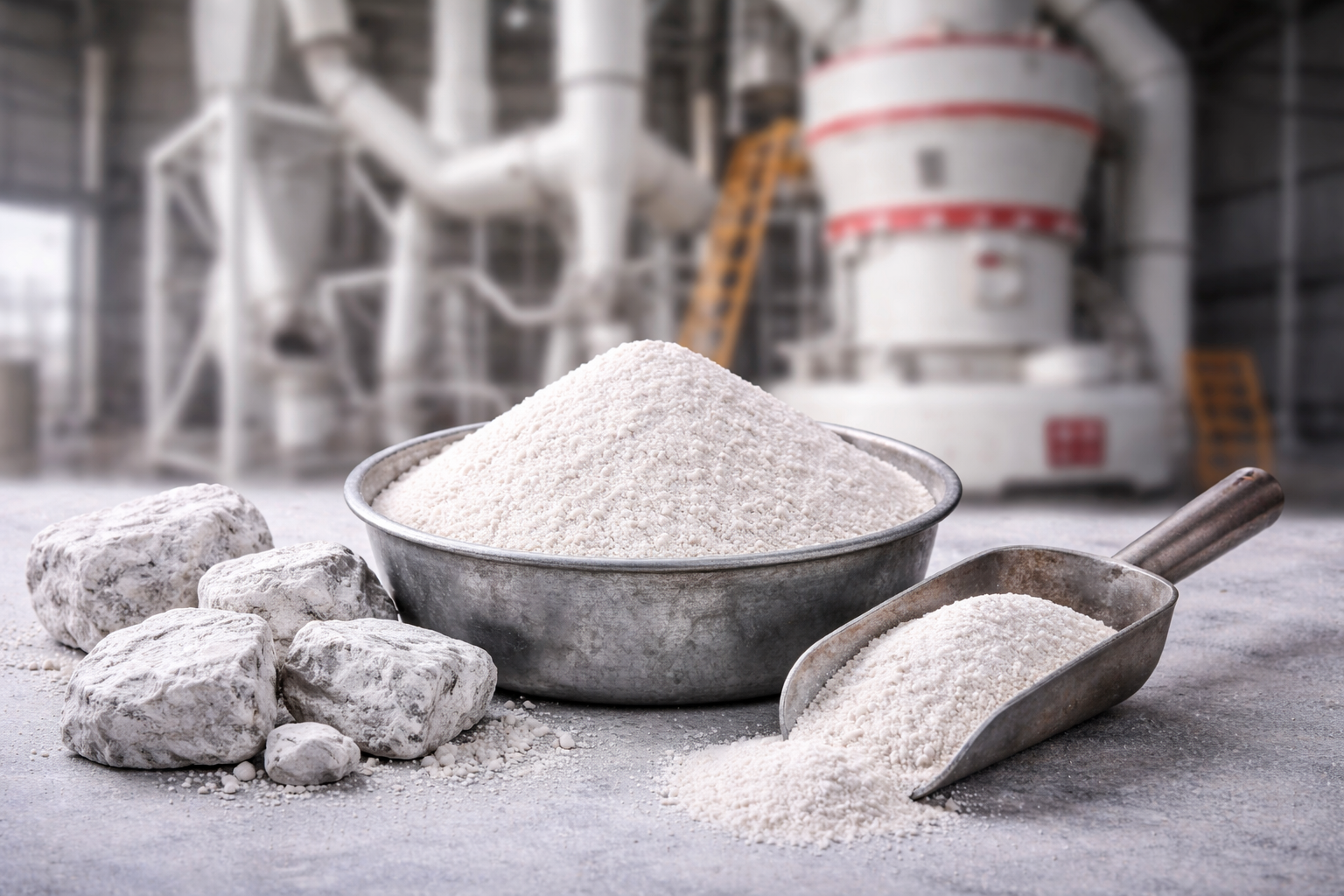
Dolomite powder is one of the most versatile industrial minerals, widely used across multiple sectors due to its unique chemical composition and physical properties. Composed primarily of calcium magnesium carbonate (CaMg(CO₃)₂), dolomite serves as both a functional filler and a performance enhancer in various applications.
Its ability to improve strength, durability, whiteness, and cost efficiency makes it a preferred choice in industries such as paints, plastics, construction, agriculture, and more.
What is Dolomite Powder?
Dolomite powder is derived from the mineral dolomite, a sedimentary rock formed over millions of years. It is processed into fine powder through crushing, grinding, and classification.
Key Characteristics:
Chemical Formula: CaMg(CO₃)₂
Color: White to off-white
Hardness: Medium (Mohs hardness ~3.5–4)
Density: High bulk density
Surface Properties: Good dispersion and compatibility
Key Properties of Dolomite Powder
1. Dual Composition Advantage
Dolomite contains both calcium and magnesium, offering better performance compared to single-component fillers like calcite.
2. High Brightness
It improves the whiteness and opacity of end products, especially in paints and coatings.
3. Controlled Particle Size
Available in various mesh sizes and micron levels, allowing customization based on application.
4. Cost Efficiency
Acts as an economical filler, reducing raw material costs without compromising quality.
5. Chemical Stability
Resistant to heat and chemical reactions, making it suitable for demanding environments.
Major Industrial Applications of Dolomite Powder
1. Paint and Coatings Industry
Dolomite powder is widely used as a filler in decorative and industrial paints.
Role:
Improves opacity and brightness
Enhances film strength and durability
Controls viscosity and flow
Reduces formulation cost
Applications:
Wall putty
Primers
Emulsions
Industrial coatings
2. Plastic Industry
Dolomite is used as a filler in thermoplastics and thermosets.
Benefits:
Improves stiffness and dimensional stability
Enhances heat resistance
Reduces polymer consumption
Applications:
PVC pipes
Injection molded products
Packaging materials
3. Construction and Building Materials
Dolomite powder plays a significant role in construction applications.
Uses:
Cement manufacturing
Concrete mixtures
Asphalt and road base
Advantages:
Improves compressive strength
Enhances durability
Provides better bonding
4. Steel and Metallurgical Industry
Dolomite is used as a flux material in steelmaking.
Functions:
Removes impurities
Protects furnace lining
Improves slag formation
5. Glass Industry
Dolomite is an essential raw material in glass production.
Role:
Acts as a source of magnesium oxide (MgO)
Improves glass durability and hardness
Prevents devitrification
6. Agriculture
Dolomite powder is widely used as a soil conditioner.
Benefits:
Neutralizes acidic soil
Provides calcium and magnesium nutrients
Improves crop yield
7. Rubber Industry
Dolomite acts as a reinforcing filler in rubber products.
Advantages:
Enhances tensile strength
Improves abrasion resistance
Reduces production cost
8. Ceramics Industry
Dolomite is used in ceramic bodies and glazes.
Benefits:
Improves thermal stability
Enhances surface finish
Reduces firing temperature
9. Detergents and Soaps
Used as a filler and mild abrasive.
Functions:
Provides bulk
Improves cleaning efficiency
Controls cost
Choosing the Right Dolomite Powder
Selecting the correct grade is critical for optimal performance.
Key Factors:
Particle Size (Mesh/Micron): Impacts smoothness and dispersion
Whiteness: Important for paints and plastics
Purity: Affects performance in sensitive applications
Oil Absorption: Influences formulation behavior
Future Demand and Market Trends
With increasing demand for cost-effective and high-performance materials, dolomite powder is gaining importance in:
Eco-friendly construction
Lightweight plastics
High-performance coatings
The push toward sustainable materials further strengthens its relevance.
Why Choosing the Right Supplier Matters
While dolomite powder is widely available, the quality, consistency, and technical support offered by your supplier can significantly impact your final product performance.
A reliable supplier ensures:
Consistent particle size distribution for uniform results
Stable chemical composition (Ca & Mg balance)
Controlled whiteness and purity
Low impurities that can affect performance
Reliable supply chain and timely delivery
In industries like paints, plastics, and construction, even small variations in raw materials can lead to issues such as poor finish, reduced strength, or inconsistent processing behavior.
About Kamal Industries
At Kamal Industries, we focus on delivering high-quality, application-specific dolomite powder tailored to industrial requirements.
With a strong presence in the mineral industry, we emphasize:
Strict quality control across every batch
Customized micron sizes and grades
Reliable supply for large-scale manufacturers
Technical understanding of end-use applications
Our approach goes beyond just supplying material—we aim to be a long-term partner in improving your product performance and cost efficiency.
Kamal Industries
Office Address: E-446 C, Matsya Industrial Area, Alwar, Rajasthan 301030.
Factory Address:
E-446 C&D, Matsya Industrial Area, Alwar, Rajasthan 301030.
G-288, Matsya Industrial Area, Alwar, Rajasthan 301030.
© 2026. All rights reserved.
Email: kamalindalwar@gmail.com
Contact No: +919351773848